Newsroom
SMEs are borrowing to survive, not to grow: what the asset finance slowdown means for brokers

- Oxcel Finance
- October 8, 2026
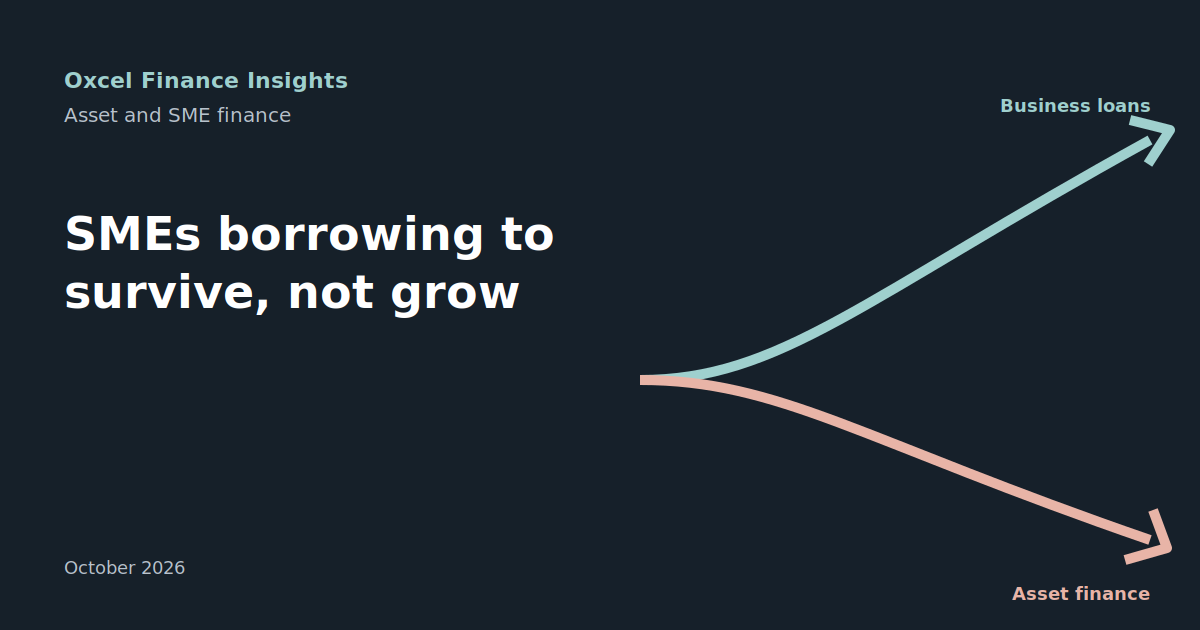
Business borrowing is rising, but not for growth. Equifax data shows business loan demand up 11.3% year on year in August 2026 while asset finance demand fell 12.7%, with SMEs extending the life of existing equipment and using credit to manage cash flow. For brokers diversifying into asset and commercial finance, the opportunity is real, but the credit risk profile has changed.
The divergence
The Equifax Business Market Pulse for August 2026 shows two lines moving in opposite directions. Business loan demand rose 11.3% year on year. Asset finance demand fell 12.7%.
The split is sharper for smaller firms. SME loan enquiries rose 4.3%, while SME asset finance applications fell 14.5%. Large business loan demand rose 19.2%.
The trend has been building for months. In July, Equifax recorded business loan demand up 6.2% and asset finance demand down 9.1%, with SME asset finance down 12.6%. August extended the gap.

Why it is happening
Equifax's commercial general manager Brad Walters has described a widespread asset capital pullback, with businesses extending the life of machinery, vehicles and IT rather than taking on new long-term debt.
The wider economy supports that reading. NAB's Q3 2026 business survey found conditions turned negative for the first time since September 2020. The RBA has raised the cash rate four times this year to 4.60%. Higher repayments make a new excavator or truck a harder decision.
The risk signals are worth noting. Equifax reported average applicant credit scores fell around two to three points year on year, suggesting more higher-risk businesses are seeking credit. Active ATO tax defaults reached 36,900 in August 2026, up 22.6%. Construction was hit hardest: ATO defaults in the sector rose 25%, and SME construction asset finance demand fell 23.5%.
Regulators are watching small business lending
ASIC's 2026–27 banking priorities letter announces a review, expected to begin in Q2 2026–27 (October–December 2026), of non-bank lending practices that can lead to poor outcomes for small businesses, including unfair contract terms. Bank lending to small business will be examined through a separate APRA review.
The details are not yet public. But brokers who place SME clients with non-bank lenders should expect closer attention to contract terms, fees and how products are matched to borrowers.
Competition for asset finance referrals is intensifying
Mortgage aggregation groups continue to build asset finance capability. Aussie, for example, has partnered with AI-led asset finance brokerage LoanOptions.ai, giving its broker network a referral pathway to a panel of more than 90 lenders. The partners cite CAFBA data suggesting 70% of customers are likely to buy an asset within nine months of buying a home.
The practical message: mortgage brokers who do not offer asset finance, directly or by referral, are leaving that demand to someone else.
Key facts
- Business loan demand: +11.3% year on year (August 2026, Equifax).
- Asset finance demand: −12.7%; SME asset finance applications −14.5%.
- Active ATO tax defaults: 36,900, up 22.6% year on year.
- SME construction asset finance demand: −23.5%.
- ASIC review of non-bank small business lending: expected Q2 2026–27.
- Commercial, business and asset finance settled by brokers in 2025: $52.3 billion (MFAA).
What this means for brokers
The growth story in asset finance has paused, at least for new equipment. Brokers should not plan 2026–27 on 2025's volumes.
The mix is shifting to working capital and restructuring. SMEs want cash-flow facilities, ATO debt refinancing and credit line restructures. Those deals need non-bank relationships and stronger credit judgement than a standard vehicle loan.
Credit quality matters more. ATO defaults are a routine serviceability issue now, especially in construction and trades. Brokers who submit weak deals will damage lender relationships at the moment lenders are tightening.
There is still opportunity. Replacement cycles do not disappear; they are delayed. Fleet and equipment owners extending asset life will eventually need finance for replacement, and brokers who stay in contact will be first in line.
What brokers should do now
- Ask every SME client about ATO debt and payment arrangements early in the fact-find.
- Build relationships with at least two non-bank working capital lenders, not only asset financiers.
- Review how you explain fees and contract terms on non-bank SME products, in light of ASIC's coming review.
- Keep in touch with clients who deferred upgrades; diarise their likely replacement timing.
- For mortgage brokers: set up a referral or accreditation pathway so home loan clients' asset needs are not lost.
Oxcel perspective
Asset finance is a relationship business. In a slower market, the brokers who keep talking to tradies, transport operators and fleet owners will be first in line when spending resumes. Diversification works best when it is backed by real training, lender access and support.
General information only. This content does not constitute financial, credit, legal or tax advice. Finance products and lending criteria are subject to lender assessment and eligibility requirements.
Sources & further reading
- Mortgage Professional Australia — Australian business loan demand surges as asset finance pullback deepens, 23 September 2026 (reporting Equifax Business Market Pulse, August 2026).
- Australian Broker — Business loan demand rebounds as firms pull back on equipment spending, August 2026.
- ASIC — Supervisory letter: 2026–27 banking sector priorities, 30 September 2026.
- NAB — NAB Quarterly Business Survey Q3 2026, 24 September 2026.
- Australian Broker — Aussie brokers gain new asset finance panel via LoanOptions.ai tie-up, 2026.






































































































































































.png)